Indoor Air Guide
What's off-gassing in your home?
New furniture, fresh paint, a scented candle, a cleaning spray, each one quietly releases chemicals you can't see or smell. Here's what VOCs actually are, what level counts as a problem, and how fast you can clear them.
Total VOCs below 220 ppb is a clean baseline; up to 660 ppb is still generally fine. Above that, you're in a "watch zone", something in the room is off-gassing, even if it's not an emergency. The EPA has not set a federally enforceable numeric standard for VOCs in homes, so these bands reflect common industry practice for consumer air-quality monitors rather than a government limit. The risk with VOCs is rarely acute poisoning; it's long-term, low-level exposure, hour after hour, which is what EPA highlights as the main concern. Open a window for 10–20 minutes and most household VOC spikes clear fast.
You can't see it. You can't smell most of it. But it's in every breath you take in a freshly painted room, near new furniture, or after a candle burns for a few hours.
Reading your indoor VOC number
Total VOCs (TVOC) is a sum of many compounds at once, so the scale is broader than a single-gas reading like CO2. The EPA does not publish a federally enforceable numeric limit for indoor VOCs, so these bands reflect widely used industry conventions for consumer air-quality monitors, calibrated against EPA's general guidance on VOC sources and health effects.
Long-term exposure, not acute poisoning, is where the real risk builds.
A new sofa, a fresh coat of paint, a candle you love, none of it feels dangerous in the moment. That's exactly why VOCs are easy to ignore.
It's not a single bad breath that matters here, it's the accumulation. Your body absorbs these compounds hour after hour in the rooms you spend the most time in, long before anything smells "off" to you.
Think about what changed in your space recently. A new purchase? A cleaning session? That's usually the source, and usually fixable in minutes.
How to clear VOCs from a room
Most VOC spikes are temporary and fixable, the trick is knowing when they're happening.
The fastest reset
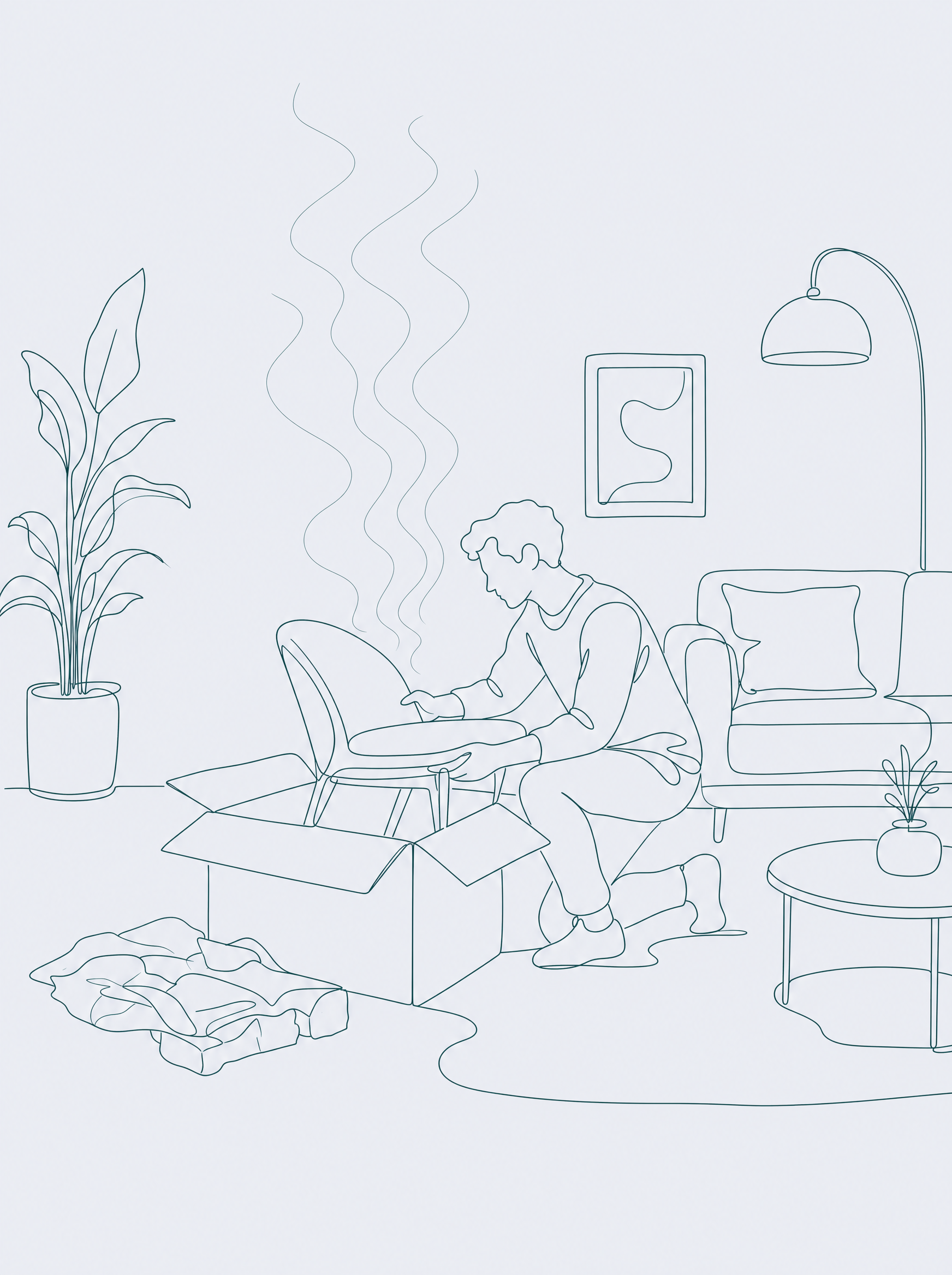
Open a window after cleaning, unboxing new furniture, or lighting a candle. Most everyday VOC spikes clear within 10–20 minutes of cross-ventilation.
Cut it off at the source
Low-VOC paint, unfinished or solid wood furniture, and fragrance-free cleaners release far less than their conventional counterparts.
Know when it's off-gassing
A real-time monitor flags the exact moment a new purchase or cleaning session pushes VOCs into the watch zone.
BAVAMA tells you when something is off-gassing.
Instead of a raw ppb figure, you get plain language: what changed, what it means, and what to do next.
- 1Live VOC tracking alongside CO2, PM2.5, humidity, and temperature, not a single metric in isolation.
- 2Plain-language explanations, so "612 ppb" becomes "something is off-gassing, find the source and ventilate."
- 3Timely nudges tied to your routines, after cleaning, after a delivery, after lighting a candle.
VOC levels, answered
VOCs (volatile organic compounds) are invisible chemicals released by everyday things: new furniture, cleaning sprays, candles, fresh paint, and air fresheners. They evaporate at room temperature, which is why a new sofa or a freshly painted room can measurably affect indoor air for days.
Below 220 ppb total VOCs is a clean baseline, and up to about 660 ppb is generally still fine for daily living. The EPA doesn't set a specific numeric limit for homes, so these figures are common consumer-monitor conventions rather than a government threshold. Above 660 ppb, treat it as a signal to find the source and ventilate, not a health emergency, but not something to ignore either.
Long-term, low-level exposure, not acute poisoning, is where the real risk builds. A single evening near a scented candle isn't the concern; breathing elevated VOCs in the same room, day after day, is what matters most.
For everyday sources (a candle, a cleaning session), 10–20 minutes of cross-ventilation usually resets the room. After painting or major renovation work, ventilate continuously for at least 48–72 hours, and expect new furniture to keep off-gassing at lower levels for days to weeks.
Standard HEPA filters capture particles, not gases, they don't meaningfully remove VOCs. You need activated carbon (or a similar adsorbent) filtration stage specifically to pull VOCs out of the air. Ventilation remains the fastest and most reliable fix.
Usually not. Most "VOC-free" or "zero-VOC" labels mean the product falls under a very low regulatory threshold, not that it contains none. Genuinely low-VOC paints still benefit from ventilation during and after application.
Early access
Be first to breathe easy.
Join the waitlist and we'll let you know the moment BAVAMA is ready to ship, plus founding-member pricing.
You're on the list. We'll be in touch.
Something went wrong. Please try again in a moment.
We'll only email you about launch. No spam, ever.